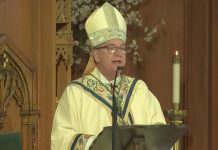
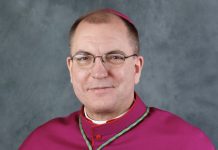
Bishop William Murphy
|
Freedom of Conscience and Freedom to Serve the Sick |
|
|
|
February 1, 2012 | The Long Island Catholic Vol. 50, No. 38 | BISHOP WILLIAM MURPHY
Like many of you in this liturgical year when the Sunday Gospels are from the Gospel of Mark, I am using Mark for my morning meditation. The morning I am writing this I prayed over Mark 3, specifically vv 10-18. Early in his mission, Mark tells us that Jesus attracted crowds, “He cured many and, as a result, those who had diseases were pressing upon him to touch him.” He then went up a mountain to pray and from there called his first apostles who had already witnessed him curing the diseased. These “He appointed as apostles to be with Him and He sent them to preach and to have authority to drive out demons.”
From the very beginning of His ministry Jesus showed Himself to be a healer, a healer of diseases, a healer of hearts and souls, a healer who always shared His healing power with all those whom He commissioned as apostles. Those apostles and the whole Church after them have always seen healing as one of the hallmarks of Jesus’ mission. In imitation of Him and in faithfulness to His command, the apostles, Peter, James, John, Paul and Barnabas, all are depicted as healing the sick, caring for the suffering and ministering to those in need. Jesus’ example was not lost on them. Neither has it been lost on the Church led by their successors, the bishops, and all those who with them shared the ministry of Jesus the Divine Healer.
|
|
|
Witness to Life; Witness to Religious Freedom |
|
|
|
January 25, 2012 | The Long Island Catholic Vol. 50, No. 37 | BISHOP WILLIAM MURPHY
On the eve of the annual Pro-Life March in Washington, Allison O’Brien, the dynamic director of our diocesan Respect Life Office, e-mailed me to say that, this year the Diocese of Rockville Centre has registered 38 buses and 1,803 people who will be participating in the March for Life on Monday, January 23. The Cathedral Parish of St. Agnes has become a central point for different areas. From the cathedral there are three buses leaving for the March. As Allison said to me, “We have a great team!”
When the Pro-Life movement was getting its start in response to Roe v. Wade 40 years ago, much of the national leadership came from lay faithful of our diocese. Bishop McGann was a staunch supporter and Bishop McHugh, as a young priest, became the engine of the Church’s pro-life efforts, nationally and internationally. What a tribute to those pioneers is this annual turnout of Long Islanders to stand up for human life, from the moment of conception to the moment of natural death and every moment in between.
|
|
The Catholic School in the Catholic Church |
|
|
|
January 18, 2012 | The Long Island Catholic Vol. 50, No. 36 | BISHOP WILLIAM MURPHY
This week’s Faith and New Works column is co-authored by Bishop William Murphy and Sister Joanne Callahan, diocesan superintendent of schools.
In the history of the Catholic Church in our country, two great apostolic initiatives have left an indelible mark and remain a great treasure for the Church and for society. One is the Catholic hospital. This week, Catholic Health Services under the guidance of St. Francis Hospital, opened the second Bishop James McHugh Health Center, in Hicksville. In addition to our six hospitals, including St. Francis, the Diocese has oversight of non-acute care facilities such as Our Lady of Consolation and Good Samaritan Hospice. This clinic in Nassau, matching the one in Bay Shore, provides local primary health care to the whole community but especially to women and children, including many for whom health care is not readily available.
|
|
Telecare: Proclaiming the Gospel Today |
|
|
|
January 11, 2012 | The Long Island Catholic Vol. 50, No. 35 | BISHOP WILLIAM MURPHY
My friend, Cardinal William Baum, who loves visiting Rockville Centre, is not the kind of person who gets excited by the latest new technology. In fact we tease him that he is the last living expert in the use of a quill pen. While most of us have become accustomed to life with computers, Blackberries and many new forms of communication, this doesn’t mean we cannot appreciate much of the past including books not on Kindle and art that we see in museums.
This past week I made my annual retreat with the Benedictine monks at St. Paul’s Outside the Wall, one of Rome’s four major basilicas. There the tradition of “Prayer and Work” which St. Benedict set forth in his rule 1500 years ago is maintained. We rise at 4:30 to begin the office of prayer and continue through the day, with Mass and the other “hours” until Compline or Night Prayer completes our daily cycle. Central to this is Gregorian chant. The beauty of this ancient form of singing psalms and prayers remains at the heart of the Church’s liturgy. It has enriched Catholic liturgical life for centuries and is one of the treasures of the Church’s life of prayer and richness of culture.
|
|
Christmas Day Homily 2011 |
|
|
|
January 4, 2012 | The Long Island Catholic Vol. 50, No. 34 | BISHOP WILLIAM MURPHY
Text of Bishop Murphy’s Christmas day homily at St. Agnes Cathedral
Five hours ago in St. Peter’s Square, Pope Benedict proclaimed to the city and the world what we have just heard in the Gospel: The Word was made flesh and dwelt among us; and we saw His glory, the glory as the Father’s only begotten Son, full of grace and truth.” That truth for more than 2,000 years has echoed from Bethlehem to Rome to Constantinople to Paris and Rio de Janeiro; from Kinshasa to Manila, from China to America and here to this cathedral and to all joining us through Telecare.
What the prophets searched for has been fulfilled: How beautiful are the feet of Him who brings good tidings … announcing salvation. For the Lord comforts His people … all the ends of the earth shall see the salvation of the Lord. Yes! Salvation! That is what the birth of Jesus means. Saved from the darkness of sin and death; saved from the endless passage of centuries wherein hope is dashed and delusion prevailed; centuries of human failure and human conceit. Time and again God sought out men and women who would come back to Him. Many heeded for a while and then fell away. Countless others were caught up in the egoism of self. But God never despaired. He knew our weakness. He created us with the gift of freedom and He knew that freedom brings risk. Liberty can be used for good or ill. He knew words alone were not enough to attract His children freely to turn and be faithful to Him. But He is always faithful for He cannot be unfaithful to Himself.
|
|
|
|
|
<< Start < Prev 1 2 3 4 5 6 7 8 9 10 Next > End >>
|
|
Page 1 of 13 |
|
|